
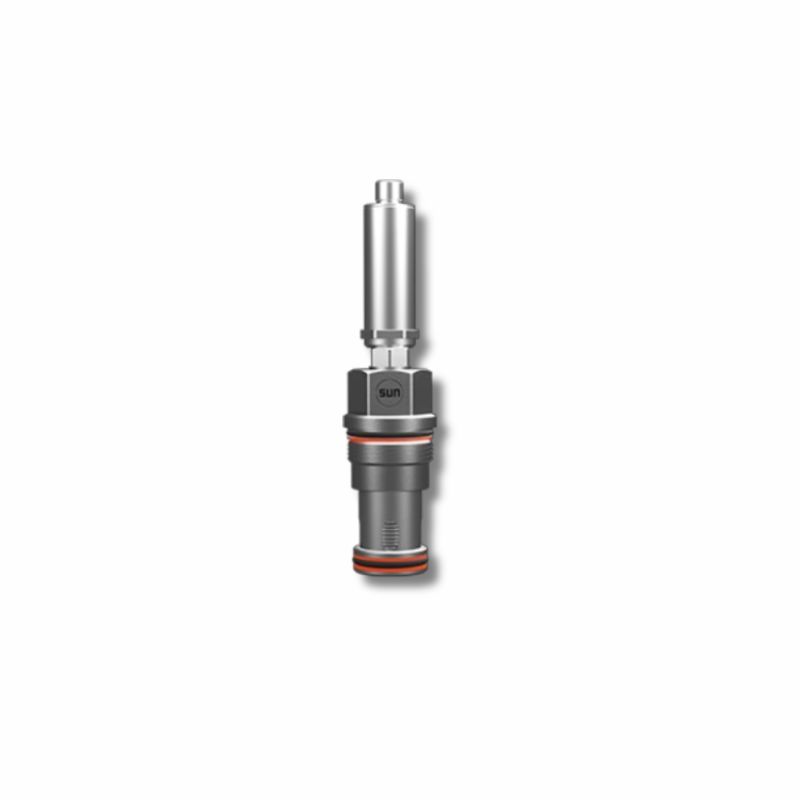
Description
What is the QMEH?
The QMEH is a cartridge-type hydraulic flow meter, applied in a T-16A cavity, designed to measure oil flow between the component’s ports and generate an electrical signal proportional to the flow rate. In practice, it acts as a compact meter integrated into the circuit, reducing the need for bulkier external solutions.
This concept is especially relevant in projects that require:
- Continuous flow reading;
- Reliable response under high pressure;
- Compact installation in manifold blocks;
- Interface with PLCs, controllers, and electronic systems;
- Signal standardization for supervision and diagnostics.
Instead of relying solely on indirect performance inferences, the system now features a real measurement point, enabling faster and more technical decisions regarding adjustment, maintenance, and process validation.
How does a cartridge-type hydraulic flow meter work?
The principle of the QMEH is based on a variable area measurement architecture, where the component detects the hydraulic flow and converts it into a proportional electrical signal. The meter reads the flow from Port 1 to Port 2, delivering an analog output compatible with the most widely used standards in the industry.
Signal options include:
- 4-20 mA;
- 0,5-4,5 V.
This point is important for industrial projects because these two ranges are widely used in automation and monitoring systems. The 4-20 mA output, for example, is especially valued for its noise immunity over longer distances. Meanwhile, the 0.5-4.5 V output can be interesting in specific electronic architectures, depending on the controller adopted.
Additionally, the component is pre-linearized and factory-calibrated, which favors measurement consistency and reduces the effort required for field adjustments.
Main technical characteristics of the QMEH
The QMEH stands out for the following parameters:
- Maximum operating pressure: up to 5000 psi, equivalent to 350 bar;
- Supply voltage: 6 to 32 VDC;
- Maximum response time: 500 ms;
- Output signals: 4-20 mA or 0.5-4.5 V;
- Repeatability: 0.6% of full scale;
- Accuracy error: up to $\pm 10\%$ of full scale;
- Electrical connector: M12 x 1, 4-pin;
- Operating temperature range: -13 °F to 176 °F;
- Reverse polarity protection: yes;
- EMC compatibility: per IEC 61000-6-4:2018 and IEC 61000-6-2:2016;
- Certifications: CE and E-Mark;
- Protection rating reported in the full datasheet: IP69K.
Another relevant technical aspect is the availability in different flow rate ranges, which allows selecting the model best suited to the circuit’s demand:
- 4 gpm — approximately 15 L/min;
- 8 gpm — approximately 30 L/min;
- 35 gpm — approximately 132 to 140 L/min;
- 50 gpm — approximately 190 to 200 L/min.
This variety broadens the product’s adaptability to different hydraulic architectures, ranging from smaller assemblies to more robust units.
Advantages of the cartridge flow meter in hydraulic designs
From an engineering standpoint, a cartridge-type flow meter offers clear benefits when compared to external measuring solutions that require more space, additional connections, and more complex arrangements.
1. Compact integration into the circuit
By using the T-16A cavity, the QMEH can be incorporated directly into blocks and hydraulic assemblies, favoring cleaner, more compact, and organized designs.
2. Monitoramento em tempo real
A possibilidade de obter leitura proporcional da vazão em tempo real melhora o controle operacional e a análise de desempenho do sistema.
3. Industrial automation compatibility
With 4-20 mA and 0.5-4.5 V outputs, the component can be integrated into panels, controllers, supervisory systems, and diagnostic routines.
4. High-pressure operation
The ability to operate up to 350 bar / 5000 psi broadens its use in severe hydraulic systems, where many low-robustness instruments fail to perform adequately.
5. Reliability for demanding environments
Certifications such as CE, E-Mark, EMC compatibility, and the IP rating provided in the documentation reinforce the product’s positioning for industrial and mobile applications.
Applications of the QMEH in hydraulic systems
The consulted content highlights the QMEH as an appropriate solution for applications requiring robust construction, reliable flow measurement, and performance under high pressure. Among the most suitable scenarios are:
- Hydraulic units;
- Hydraulic test equipment;
- Telehandlers;
- Excavators;
- Mobile machines;
- Validation test benches;
- Systems with electronic performance control;
- Hydraulic assemblies requiring continuous diagnostics.
In practical terms, this type of meter can be adopted for:
- Validating the actual performance of a circuit;
- Tracking flow rate variations throughout operation;
- Identify loss of efficiency;
- Support predictive maintenance;
- Check the system’s behavior after retrofit or technical intervention;
- Compare nominal condition versus actual field condition.
When does it make sense to use a hydraulic flow meter with an electrical output?
The use of a hydraulic flow meter with an analog signal makes a lot of sense when the operation needs to go beyond simple circuit assembly and start working with measurable data. This is especially true for companies seeking to raise the level of reliability in maintenance, application engineering, and industrial automation.
The main cases include:
- Systems that require continuous monitoring;
- Machines that require quick diagnostics;
- Projects with electronic interface and supervision;
- Validation of hydraulic performance on a test bench;
- Applications where flow rate needs to be incorporated into the control logic.
In this context, the QMEH is positioned as a high-value technical component, as it connects the hydraulic universe to the electronic process control universe.
Technical differentiators that reinforce the QMEH’s positioning The material consulted points out some relevant differentiators for organic ranking as well as for technically convincing the reader:
- Patented sensor;
- Factory calibration and linearization;
- High-pressure operation;
- Installation in a standardized cavity;
- EMC compatibility;
- Widely used analog signals;
- Application in mobile machinery and industrial systems;
- Focus on reading reliability and signal integrity.
These elements are important because the technical audience typically searches for combinations such as 4-20 mA hydraulic flow meter, 350 bar flow meter, hydraulic flow sensor for manifold, T-16A cartridge flow meter, and flow measurement for hydraulic power unit. Well-structured content built around these terms tends to gain relevance in organic search results.
Conclusion
The QMEH represents a modern solution for real-time hydraulic flow measurement, combining a cartridge format, robustness for high pressure, standardized electrical outputs, and easy integration into industrial and mobile hydraulic projects. For applications that require reliable control, monitoring, and diagnostics, it is a component with strong technical and operational appeal.
By incorporating a meter like this into the system, engineering gains greater visibility into the circuit’s actual behavior, improves performance analysis capability, and creates a more solid foundation for maintenance, automation, and decision-making.
Também disponível em:
 Português (Portuguese (Brazil))
  Español (Spanish)


